Does Water Baptism Really Save You, or is it the Spirit Baptism? Part 1
When we consider the scriptures from within the first-century Jewish idioms, is it the water baptism or the Spirit baptism that is required?
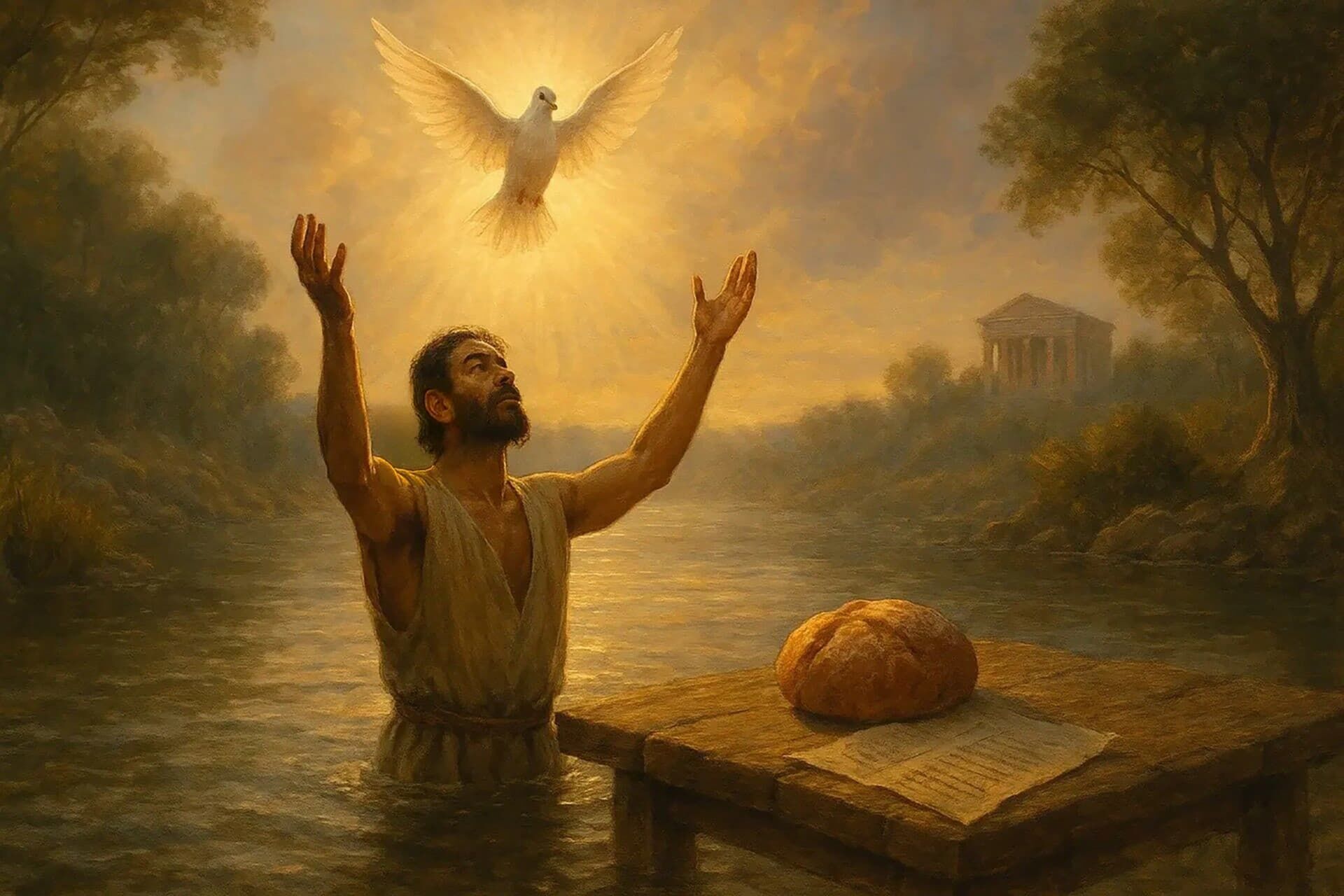
To understand what “baptism” meant to first-century Jews, a few important points must be established—especially how their baptisms differed from the Roman Catholic water baptisms that developed later.
As we see in the scriptures below, for the early Jews, “baptism” or “baptized” was often synonymous with “washing” or “washed,” (always in the context of a ceremonial washing). However, English translators often use a different English word here, which obscures how these early Jews used this Greek word for baptism. The English words bolded below are, in fact, translations of the Greek word for “baptism” (βάπτισμα) in the original Greek texts:
NAS Luke 11:37-38 Now when He had spoken, a Pharisee asked Him to have lunch with him; and He went in, and reclined at the table. And when the Pharisee saw it, he was surprised that He had not first ceremonially washed before the meal.
GNT Luke 11:38 ὁ δὲ Φαρισαῖος ἰδὼν ἐθαύμασεν ὅτι οὐ πρῶτον ἐβαπτίσθη πρὸ τοῦ ἀρίστου.
This “baptism” that Jesus did not perform here was a ceremonial washing of the hands up to the wrist before eating bread, as a better translation of the Greek reveals (see verse 3 below). Again, the words bolded (in verse 4 below) are this Greek word for “baptize” in the actual scripture:
NAS Mark 7:2 and had seen that some of His disciples were eating their bread with impure hands, that is, unwashed.
YLT Mark 7:3 for the Pharisees, and all the Jews, if they do not wash the hands to the wrist, do not eat, holding the tradition of the elders,
NAS Mark 7:4 and when they come from the market place, they do not eat unless they cleanse themselves; and there are many other things which they have received in order to observe, such as the washing of cups and pitchers and copper pots.)
GNT Mark 7:4 καὶ ἀπ᾽ ἀγορᾶς ἐὰν μὴ βαπτίσωνται οὐκ ἐσθίουσιν, καὶ ἄλλα πολλά ἐστιν ἃ παρέλαβον κρατεῖν, βαπτισμοὺς ποτηρίων καὶ ξεστῶν καὶ χαλκίων [καὶ κλινῶν]
English translators, not wanting to associate Jewish baptisms with Christian baptism, often render the Greek word as “washing,” “washed,” or “cleanse,” rather than “baptism.” This disconnects Jewish baptisms/washings from Christian water baptism. These scriptures reveal that there was a long history of Jews using the word baptism to describe their ceremonial washings well before the ministries of Jesus and John the Baptist.
Baptisms, washings, before entering the Temple
Jewish history is clear that these ceremonial washings (baptisms) were a required practice before anyone could enter the Temple. The famous rabbinic scholar Moses Maimonides, in The Guide for the Perplexed, explained that even those who were already clean had to first undergo ritual immersion (i.e., baptism) before entering the Temple precincts:
Our Sages, as is well known, said, “Even a clean person may not enter the Sanctuary for the purpose of performing divine service, unless he takes previously a bath.” By such acts the reverence [for the Sanctuary] will continue, the right impression will be produced which leads man, as is intended, to humility.[1]
And first-century Jewish philosopher Philo echoes the same understanding:
It is necessary, therefore, for those who are about to go into the temple to partake of the sacrifice, to be cleansed as to their bodies and as to their souls before their bodies.[2]
Archaeologists have uncovered numerous mikvehs (ritual baths) surrounding the Temple, confirming the widespread practice of these pre-Temple ceremonial immersions.
Paul and the Spirit Baptism
Paul shows that under the New Covenant the water baptisms are no longer required. Again, most English translations avoid using the word “baptisms” here because they assume the “Christian” water baptism was to continue. So they instead substitute words like “washings” for the water baptisms that Paul says are no longer imposed:
NAS Hebrews 9:9-10 which is a symbol for the present time. Accordingly both gifts and sacrifices are offered which cannot make the worshiper perfect in conscience,since they relate only to food and drink and various washings, regulations for the body imposed until a time of reformation.
GNT Hebrews 9:10 μόνον ἐπὶ βρώμασιν καὶ πόμασιν καὶ διαφόροις βαπτισμοῖς, δικαιώματα σαρκὸς μέχρι καιροῦ διορθώσεως ἐπικείμενα.:
Paul plainly states above that the water baptisms (washings) are no longer “imposed” under the New Covenant. Most English translators cannot bear to say that “baptisms” are no longer required, so they soften the word to “washings” instead.
Paul’s understanding here explains why he writes what he did to the Corinthians:
NAS 1 Corinthians 1:14 I thank God that I baptized none of you except Crispus and Gaius,
NAS 1 Corinthians 1:17 For Christ did not send me to baptize, but to preach the gospel, not in cleverness of speech, that the cross of Christ should not be made void.
Although Paul at first water baptized a few individuals, he soon realized that there is now only one baptism—the Spirit baptism brought by the Lord Jesus:
NAS Ephesians 4:5 one Lord, one faith, one baptism,
NAS 1 Corinthians 12:13 For by one Spirit we were all baptized into one body, whether Jews or Greeks, whether slaves or free, and we were all made to drink of one Spirit.
Paul understood that it was the Spirit baptism that brings salvation in the New Covenant. It is this Spirit washing that brings us into the spiritual body of Christ, as Paul said above.
Because of Roman traditions, many Christians automatically associate the word baptism with water, but God Almighty said that His Son would bring a spiritual baptism, a spiritual washing:
NAS John 1:33 “And I did not recognize Him, but He who sent me to baptize in water said to me, ‘He upon whom you see the Spirit descending and remaining upon Him, this is the one who baptizes in the Holy Spirit.’
The renowned prophet John the Baptist said the very same thing:
NAS Mark 1:8 “I baptized you with water; but He will baptize you with the Holy Spirit.”
And the scriptures show Jesus said this on various occasions:
NAS Acts 1:5 for John baptized with water, but you shall be baptized with the Holy Spirit not many days from now.”
Peter remembered that the Lord told them this multiple times:
NAS Acts 11:16 “And I remembered the word of the Lord, how He used to say, ‘John baptized with water, but you shall be baptized with the Holy Spirit.’
The Meaning and Power of Spirit Baptism
With the spiritual washing the Lord Jesus brought in you do not need a man to bring you salvation using a water baptism. Anyone can believe and receive the spiritual washing, forgiveness, and “new birth” by believing in the Lord Jesus and his accomplished work.
Spirit baptism occurs when a person believes in and receives Christ; they are washed, cleansed, forgiven, and “born again” (or more literally, as the Greek indicates, born/generated from above). Their human spirit comes alive, entering into direct communion with God the Father and His Son, Jesus Christ, and they become part of Christ’s spiritual body.
In contrast, the doctrine of “Christian” water baptism requires a man (priest, pastor, minister, rabbi, etc.) to perform a ritual with water in order to bring salvation. In this teaching—one that many sincere people have inherited today—Christ’s shed blood and the washing of the Holy Spirit are not enough to bring salvation. A person must still perform the water ritual and have the correct baptismal formula spoken (which varies between churches, as they disagree on the proper wording).
Yet God’s Word teaches we are saved and washed by what Jesus accomplished:
NKJ Revelation 1:5 and from Jesus Christ, the faithful witness, the firstborn from the dead, and the ruler over the kings of the earth. To Him who loved us and washed us from our sins in His own blood,
The tradition inherited from Rome teaches that even this is not sufficient for salvation; a man must also perform the water baptismal rite.
The Early Jewish Believers Say “Baptism Is Not Necessary”
Most Christians today are unaware that the earliest Messianic Jewish believers argued with the Roman Catholic Church insisting that water baptism was no longer necessary—rightly seeing it as an Old Covenant ritual that was no longer imposed.
In his treatise “On Baptism,” Tertullian, called the father of Latin (Roman) Christianity, writing around 180 AD, argues against these Jewish believers. He quotes some of the statements made by them, such as the following, where Tertullian writes how these Jewish believers dared to question Roman theology:
Here, then, those miscreants provoke questions. And so they say, “Baptism is not necessary for them to whom faith is sufficient; for withal, Abraham pleased God by a sacrament of no water, but of faith.”[3]
The early Jewish believers correctly pointed out that Abraham was justified by faith, not by a Roman sacrament of water baptism. Tertullian, however, argued that water baptism itself cleansed sins, and brought eternal life:
Happy is our sacrament of water, in that, by washing away the sins of our early blindness we are set free and admitted into eternal life![4]
Tertullian continues:
But they roll back an objection from that apostle himself, in that he said, ‘For Christ sent me not to baptize;’ as if by this argument baptism were done away! [5]
And, of course, the Jewish believers raised a conclusive point: If water baptism saves, why would the apostle Paul thank God for baptizing so few, and then state that Christ did not send him to baptize?
Misunderstood Scriptures
Some commentators argue that Paul stopped baptizing because people might claim he baptized in his own name, as if saying: “I now baptize you in the name of Paul.” But that is not what Paul meant:
NAS 1 Corinthians 1:15 that no man should say you were baptized in my name.
Paul, a bold and faithful apostle (see Acts 20:27), would not stop baptizing (if it saved souls) simply because some might falsely accuse him. He certainly would not “thank God” for refusing to perform God’s supposed requirement for salvation.
The best explanation is that Paul initially practiced Jewish water immersions rooted in Old Testament tradition, but soon realized that under the New Covenant these were no longer necessary, and ceased practicing them—thanking God for his clearer understanding.
Paul wanted no association between his name and water baptisms because he had fully embraced Spirit baptism—the true baptism instituted by the Messiah.
Another argument suggests Paul stopped baptizing because of divisions in Corinth. But this cannot be, since Paul had ministered in Corinth for 18 months after baptizing Crispus (Acts 18:8–11), and he only recently learned of the divisions:
KJV 1 Corinthians 1:10 Now I beseech you, brethren, by the name of our Lord Jesus Christ, that ye all speak the same thing, and that there be no divisions among you; but that ye be perfectly joined together in the same mind and in the same judgment.
KJV 1 Corinthians 1:11 For it hath been declared unto me of you, my brethren, by them which are of the house of Chloe, that there are contentions among you.
Thus, the divisions were not the reason Paul had baptized so few over those 18 months.
In reality, as previously shown, Paul understood that the Spirit baptism brings us into Christ’s body:
NAS 1 Corinthians 12:13 For by one Spirit we were all baptized into one body…
Summary and Another Look at Key Scriptures
In Part 2 of this blog study, we will examine additional scriptures that are often misunderstood to support water baptism, as a requirement for salvation (but all the scriptures are in the book).
For now, it is important to emphasize that the Lord Jesus never commanded anyone to baptize others in water, nor is there any record of Him baptizing anyone in water (Matthew 28:19 is covered in chapter 3, section 5-7, and in chapter 5, section 3). We have already reviewed some key scriptures on why this is true:
NAS John 1:33 “And I did not recognize Him, but He who sent me to baptize in water said to me, ‘He upon whom you see the Spirit descending and remaining upon Him, this is the one who baptizes in the Holy Spirit.’
NAS Mark 1:8 “I baptized you with water; but He will baptize you with the Holy Spirit.”
NAS Acts 1:5 for John baptized with water, but you shall be baptized with the Holy Spirit not many days from now.”
NAS Acts 11:16 “And I remembered the word of the Lord, how He used to say, ‘John baptized with water, but you shall be baptized with the Holy Spirit.’
Footnotes
[1] Maimonides, The Guide for the Perplexed, Part 3, ch. 47, pp. 367–368,
[2] Yonge, The Works of Philo Judaeus, “Special Laws I,” 50:269,
[3] https://www.newadvent.org/fathers/0321.htm
Share it:

Blog Categories

The Messiah’s Baptism
The Messiah’s Baptism reexamines scripture to reveal whether Church tradition—Roman or Protestant—has overlooked key truths about this vital subject.