Jesus Turned the Baptismal Water into Wine, Part 1
When we consider how Jesus responded to some of the ritual washings in his day (which the Jews called “baptisms” in the Greek), a very different picture begins to emerge—starting with his very first miracle!
Jesus Turned the Baptismal Water into Wine!
The New Testament’s language about baptism looks very different when read through the world of first-century Israel.
Why question water baptism?
If the New Testament actually teaches that Spirit baptism replaced the ceremonial water baptisms, then this is not a minor doctrinal question. It would mean that a practice accepted by nearly every church deserves to be reexamined—not according to centuries of church tradition, but according to what the New Testament itself teaches.
If water baptism was never commanded for the New Covenant, then we also have to ask how a Jewish ceremonial practice became one of Christianity’s most widely observed rituals.
To answer that question, we have to go back before denominations, before Protestantism, and before the later sacramental theology of the Roman Church—to the Jewish world of Jesus, John the Baptist, and the apostles.
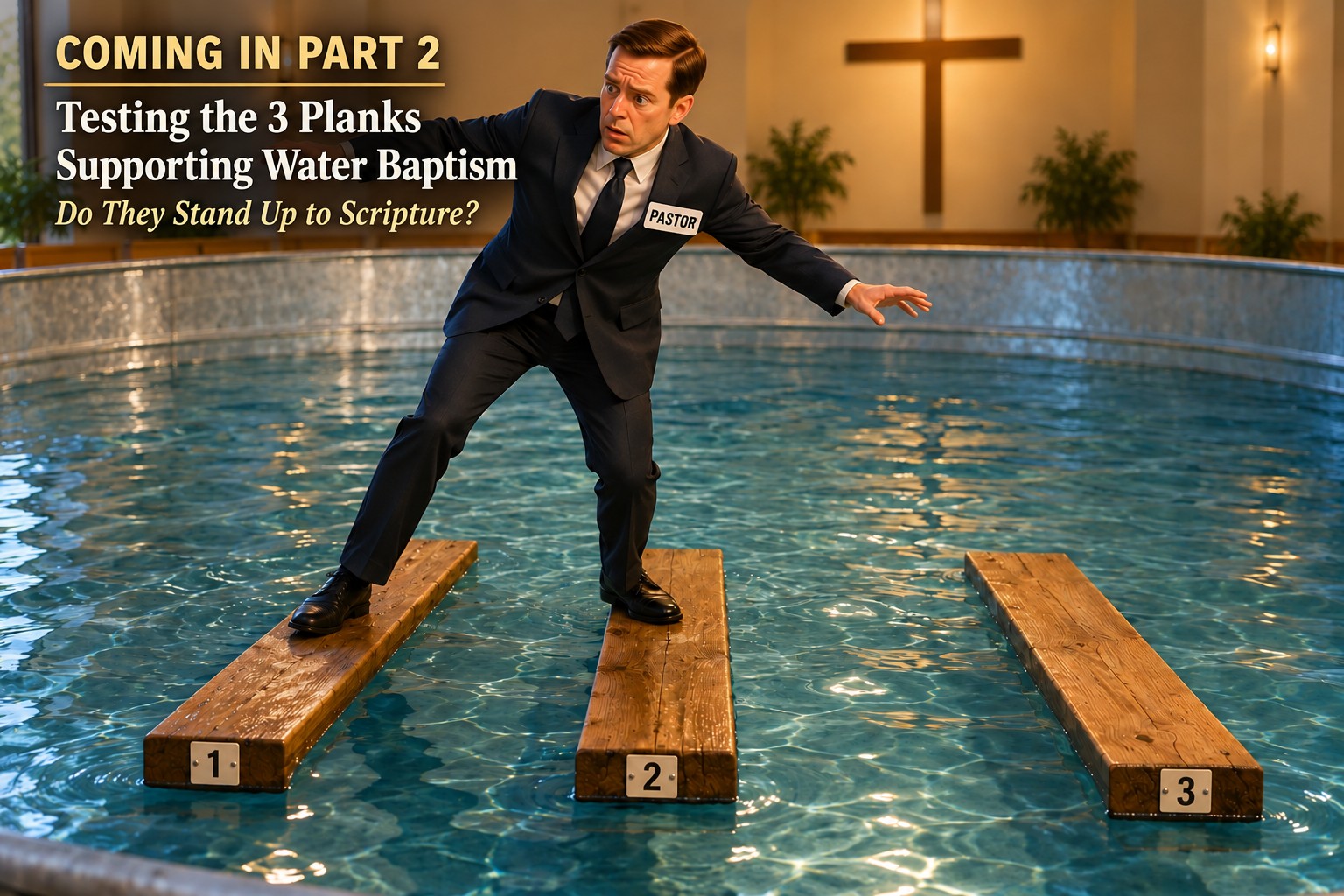
In Part 1 of this three-part series, we will consider how Jesus treated the various water baptism traditions when they were not from God. In Part 2 we will test the three main teaching planks (pictured above) for water baptism using the scriptures. And in Part 3, among other things, we will see how this water rite took hold in the New Covenant.
In his very first miracle, Jesus did not just turn the water into wine…
…He turned the baptismal water (the water for ritual purification) into wine!
Why would the very first miracle by Jesus be turning baptismal water into wine? Wouldn’t healing a blind child or a leper be a more powerful first miracle?
See John 2:1–12
This very first miracle of Jesus wasn’t just any water, with no meaning; it was the water for ceremonial cleansings, the water used for Jewish baptisms. Jesus turned the baptismal water into the wine of rejoicing:
NIV John 2:6 Nearby stood six stone water jars, the kind used by the Jews for ceremonial washing, each holding from twenty to thirty gallons.
Changing the water used for ceremonial cleansing into wine surely would have upset some Pharisees. Just as turning the water to wine in a church baptismal tank would trouble many today. And if someone at this wedding in Cana needed to perform a ritual washing, what would they do now?
KJV John 2:11 This beginning of miracles did Jesus in Cana of Galilee, and manifested forth his glory; and his disciples believed on him
The Greek word translated as miracles is actually signs:
Strong’s: <4592> σημεῖον (semeion)
Meaning: a sign
So, what was this sign? A sign points to something or says something is coming. Does this particular sign from Jesuspoint to something much greater? When seen through the lens of Jewish purifications and water baptisms, then yes, this sign surely does appear to point forward to something significant.
Does this sign indicate that they were moving away from the Old Covenant ritual washings and ceremonial baptisms and moving forward to the heavenly wine, the Spirit washing that Jesus would bring in? I believe the evidence says yes, as this was an overarching theme of his ministry, as we will see.
In Scripture, wine is often associated with joy, gladness, and blessing, and in that sense can picture the joy and blessing associated with the Holy Spirit.
NAS Psalm 104:15 And wine which makes man’s heart glad…
At the Last Supper, Jesus (and later Paul) connected the wine to partaking of the Holy Spirit:
NAS Mark 14:25 “Truly I say to you, I shall never again drink of the fruit of the vine until that day when I drink it new in the kingdom of God.”
NAS Luke 22:30 that you may eat and drink at My table in My kingdom…
At this Last Supper, Jesus showed the fruit of the vine represented the promised New Covenant (and all its blessings, like receiving the Holy Spirit):
NAS Luke 22:20 And in the same way He took the cup after they had eaten, saying, “This cup which is poured out for you is the new covenant in My blood.
Later, Paul explained what Jesus really meant about drinking wine in his kingdom. They would not be drinking literal wine as Jesus said, but rather the spiritual fruit of the vine, such as the joy in the Holy Spirit:
NAS Romans 14:17 for the kingdom of God is not eating and drinking, but righteousness and peace and joy in the Holy Spirit.
I like how the following study note on Bible Gateway describes the significance of the wedding miracle in Cana:
“The water of Jewish ritual purification has become the wine of the new messianic age.” 1
And when the apostles got filled with the Holy Spirit, they were continually filled with joy:
NAS Acts 13:52 And the disciples were continually filled with joy and with the Holy Spirit.
This is exactly what God Himself told the prophet John (the Baptist) would happen—that His son, Jesus, would move away from water washing and bring the Spirit washing:
NAS John 1:33 “And I did not recognize Him, but He who sent me to baptize in water said to me, ‘He upon whom you see the Spirit descending and remaining upon Him, this is the one who baptizes in the Holy Spirit.’
YLT Mark 1:8 I indeed did baptize you with water, but he shall baptize you with the Holy Spirit.’
God directly gave this revelation to John the Baptist, showing this change away from the ceremonial water baptisms and into the true baptism, the Spirit baptism.
And this was a major part of what the earthly ministry of Jesus would accomplish; as he said, unless he goes away, the comforter (the Holy Spirit) would not come (John 16:7).
What Jesus accomplished redeemed us from the curse of the law and set us free to love and worship God in Spirit and truth. This Holy Spirit baptism is what Jesus said would happen on numerous occasions, as Peter said:
NAS Acts 11:16 “And I remembered the word of the Lord, how He used to say, ‘John baptized with water, but you shall be baptized with the Holy Spirit.’
Jesus and the Ceremonial Baptisms
We know that John’s (Old Covenant) water baptism was from God, but Jesus was not following the water baptisms when they were not God’s will, no matter how strong the tradition was:
NAS Luke 11:37 Now when He had spoken, a Pharisee asked Him to have lunch with him; and He went in, and reclined at the table.
NAS Luke 11:38 And when the Pharisee saw it, he was surprised that He had not first ceremonially washed before the meal.
The actual God-inspired Greek text says Jesus did not first “baptize” himself:
YLT Luke 11:38 and the Pharisee having seen, did wonder that he did not first baptize himself before the dinner.
GNT Luke 11:38 ὁ δὲ Φαρισαῖος ἰδὼν ἐθαύμασεν ὅτι οὐ πρῶτον ἐβαπτίσθη πρὸ τοῦ ἀρίστου.
NAS Luke 11:39 But the Lord said to him, “Now you Pharisees clean the outside of the cup and of the platter; but inside of you, you are full of robbery and wickedness.
How would Jesus “baptize himself”? This shows that the Jews used this term differently than we would today.
Here is another example where Jesus did not follow the very strong tradition of water baptisms for ceremonial cleansing. His new wine (New Covenant teachings) did not fit into their Pharisaic (Old Covenant) wineskins:
NAS Mark 7:1 And the Pharisees and some of the scribes gathered together around Him when they had come from Jerusalem,
2 and had seen that some of His disciples were eating their bread with impure hands, that is, unwashed.
3 (For the Pharisees and all the Jews do not eat unless they carefully wash their hands, thus observing the traditions of the elders;
4 and when they come from the market place, they do not eat unless they cleanse themselves; and there are many other things which they have received in order to observe, such as the washing of cups and pitchers and copper pots.)
The original Greek text actually uses the words baptize and baptisms here:
YLT Mark 7:3 for the Pharisees, and all the Jews, if they do not wash the hands to the wrist, do not eat, holding the tradition of the elders,
YLT Mark 7:4 and, coming from the market-place, if they do not baptize themselves, they do not eat; and many other things there are that they received to hold, baptisms of cups, and pots, and brazen vessels, and couches.
This was one of the Jewish water immersions (baptisms for ritual purity)—a washing of the hands to the wrists, such as after coming home from the marketplace, or any time before eating bread (a tradition created by the Pharisees to emulate God’s commands for the Showbread). This is what the waterpots in Cana were for, the contents of which Jesus turned to wine. Jesus did not follow these ritualistic baptisms because they were not from God.
Although the actual Greek words in the text of Mark are the words for baptize and baptisms, most English translations use words like cleanse or washing as we see above, when referring to the Jewish baptisms. As a result, English translations can hide from the reader a lexical connection between these Jewish baptisms and what is commonly called Christian baptism that is plainly visible in Greek.
So, when Paul thanked God that he baptized so few and said that Christ did not send him to baptize, and when Hebrews says that the “various baptisms” were imposed only until a time of reformation, these passages are referring to the same broad category of water baptisms—including that called Christian water baptism (more on this later).
Continuing with the baptisms in Mark 7:
NAS Mark 7:5 And the Pharisees and the scribes asked Him, “Why do Your disciples not walk according to the tradition of the elders, but eat their bread with impure hands?”
6 And He said to them, “Rightly did Isaiah prophesy of you hypocrites, as it is written, ‘This people honors Me with their lips, But their heart is far away from Me.
7 ‘But in vain do they worship Me, Teaching as doctrines the precepts of men.’
8 “Neglecting the commandment of God, you hold to the tradition of men.”
9 He was also saying to them, “You nicely set aside the commandment of God in order to keep your tradition.
We will see later in Tertullian’s treatise that this is exactly what the Roman Church did: they set aside the commandment of God (the Spirit baptism) and kept their tradition of water baptism.
Shortly after Jesus turned the baptismal water into wine, he taught about not putting new wine into old wineskins. The ceremonial baptisms of Mark 7 are one more example of the old religious system into which the New Covenant teachings of Jesus did not fit. He was saying this to the Pharisees:
NAS Mark 2:22 “And no one puts new wine into old wineskins; otherwise the wine will burst the skins, and the wine is lost, and the skins as well; but one puts new wine into fresh wineskins.”
Some point to John 3:22 and ask, ‘Wasn’t Jesus baptizing people with water here?’
NAS John 3:22 After these things Jesus and His disciples came into the land of Judea, and there He was spending time with them and baptizing.
Remember this was the time of the Old Covenant, and water immersions were necessary to enter the temple and to be ritually clean before a feast day. However, even here, we are told later, that Jesus himself was not participating:
NAS John 4:1 When therefore the Lord knew that the Pharisees had heard that Jesus was making and baptizing more disciples than John
2 (although Jesus Himself was not baptizing, but His disciples were)…
Why would Jesus not join in and do water baptisms like the great prophet John the Baptist? Because his calling from God was not to bring water baptism, but Spirit baptism, as the scriptures we saw earlier made clear.
But if water baptism was not the baptism Jesus came to bring, what about the main passages used today to teach that water baptism is still required? In Part 2, we will examine the three main planks of that teaching one by one, to see whether they stand the test of Scripture.
Share it:

Blog Categories

The Messiah’s Baptism
The Messiah’s Baptism reexamines scripture to reveal whether Church tradition—Roman or Protestant—has overlooked key truths about this vital subject.