Jesus Turned the Baptismal Water Into Wine,Part 3
If Jesus came to baptize with the Holy Spirit, how did water baptism become such a widespread Christian practice? In Part 3, we explore the historical development of this tradition and its relationship to New Covenant teaching.
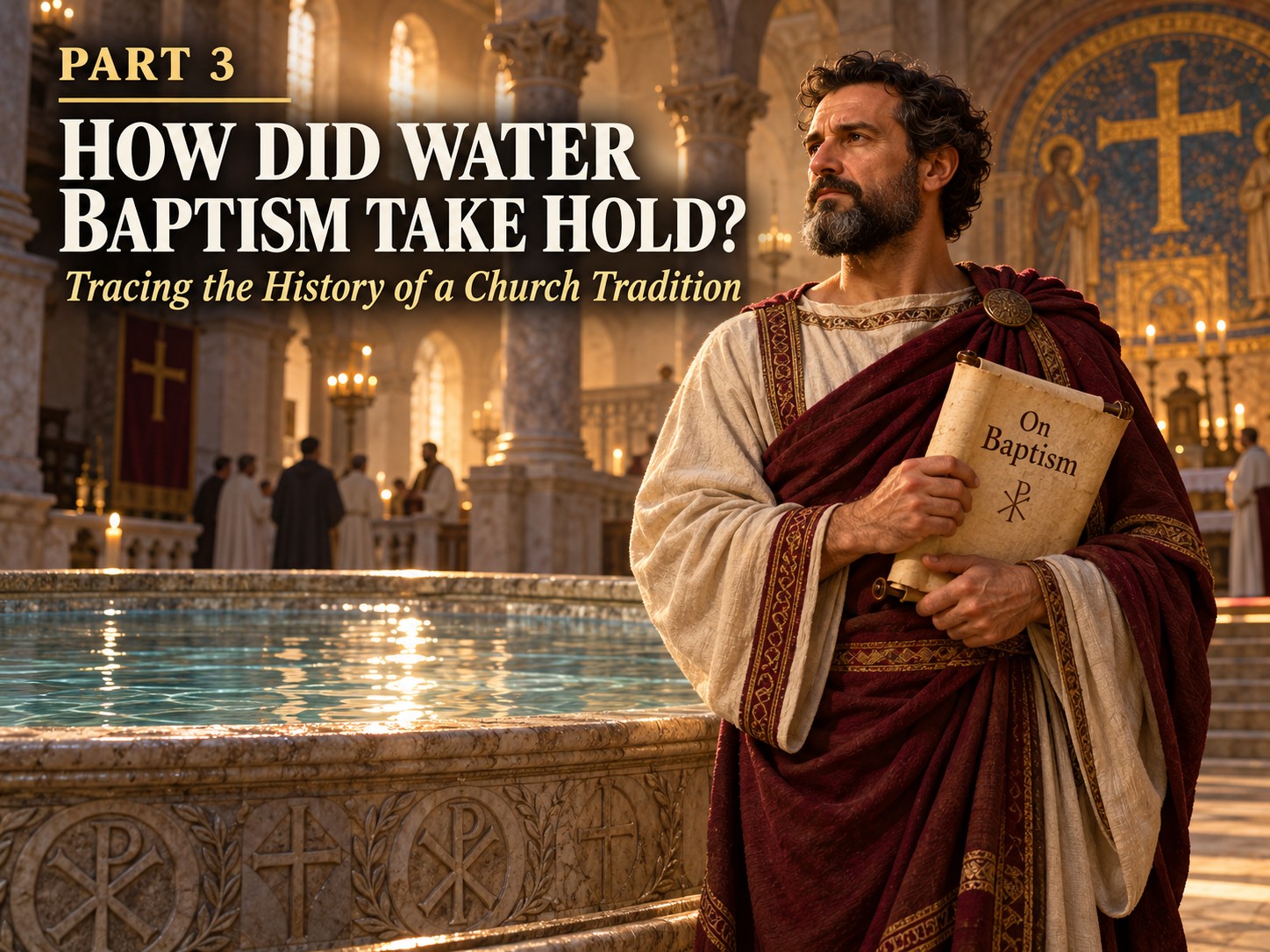
Jesus Turned the Baptismal Water into Wine!
In the first part of this series, we saw that Jesus did not show respect for the water baptisms that were not commanded by God but were traditions of man. In Part 2, we saw that the three main teaching planks for water baptism being supposedly required by God all failed when put to the test of the scripture.
Here in Part 3, we will consider a few more baptism points that have not yet been covered, and then we will examine the history of how this water rite became so pervasive throughout much of Christianity today.
Before turning to that history, however, there is one more passage commonly understood as an example of Paul performing water baptism that needs to be considered: Acts 19:1–6. The word “water” is again missing here, so we should not assume a water baptism unless the context gives us good reason to do so. And more importantly, Acts 19 does not stand alone. It follows immediately after Acts 18, where Paul had spent eighteen months with the Corinthians (Acts 18:1, 11), initially baptizing a few people and then discontinuing the practice altogether, even thanking God that he had baptized so few..
So, it would be difficult to understand Paul as suddenly reversing his stance on water baptism and then starting to perform it again. These followers of John the Baptist were not baptized with water by Paul; based on the context of Acts 18, it is much more likely that they were baptized spiritually right when they believed in Jesus, just as we have seen from all the scriptures that teach this:
NAS Acts 19:5 And when they heard this, they were baptized in the name of the Lord Jesus.
The same is true for those in Acts 8 below. They were most likely “baptized/washed” spiritually right when they believed. We always need to be careful to not read the word water into the text when it is not there:
NAS Acts 8:12 But when they believed Philip preaching the good news about the kingdom of God and the name of Jesus Christ, they were being baptized, men and women alike.
This would align with all that Jesus taught, not to mention Paul, Peter, John the apostle, and John the Baptist. As we have seen, they all taught that whoever believes is born of God, washed, and forgiven. And as we saw Paul teach, in the New Covenant we were all baptized “by one Spirit.”
So, either the baptism described in Acts 8 refers to being Spirit baptized/washed right when they believed, or it was part of the transition into New Covenant truth, where like Paul, Philip had not yet received the full revelation and performed a few water baptisms early on.
In Part 2, we have seen why the three planks of the water baptism doctrine have all failed. We are not “born again” at a water baptism, so water baptism does not bring forgiveness and salvation. It also does not clear our conscience, and finally, we saw that our “old man” is not buried in water.
Tertullian and His Treatise On Baptism
Since water baptism does none of these things, why do almost all churches perform this water rite? One influential early defender of water baptism was the Christian theologian Tertullian (often called the Father of Latin Christianity), who taught that it was required for salvation in his treatise titled On Baptism, around AD 180–200. His teachings became part of the influential Latin Christian tradition.
Tertullian wrote his treatise against believers in Jesus who were rejecting the necessity of water baptism and appealing to Paul’s teachings in support of their position. In my research, many of these were most likely among the predominantly Jewish believers who were resisting the developing doctrines and authority of Rome. There was a long and well-documented history of this division, with Jewish believers repeatedly coming into conflict with Roman church authority and even facing excommunication on multiple occasions.
Much of that history is covered in my book The Messianic Feast, in the chapter titled “The Jewish Disconnect.” I believe this conflict provides an important backdrop to Tertullian’s writings and helps explain some of his language against these believers. The Roman Church taught that everyone needed to receive its version of water baptism for forgiveness, and that gave it control (even over kings) down through history.
Tertullian states,
Happy is our sacrament of water, in that, by washing away the sins of our early blindness we are set free and admitted into eternal life! 1
Does that align with what Jesus and the apostles taught?!
Tertullian writes against those believers who agreed with Paul that water baptism was no longer to be imposed. Tertullian calls them miscreants for not following the Roman sacrament:
Here, then, those miscreants provoke questions. And so they say, “Baptism is not necessary for them to whom faith is sufficient; for withal, Abraham pleased God by a sacrament of no water, but of faith.” 2
Tertullian argues against these believers in the Messiah and their statement that salvation is by faith:
For the law of baptizing has been imposed, and the formula prescribed: “Go,” He saith, “teach the nations, baptizing them into the name of the Father, and of the Son, and of the Holy Spirit.” 3
He continues:
“But they roll back an objection from that apostle himself, in that he said, ‘For Christ sent me not to baptize;” as if by this argument baptism were done away! For if so, why did he baptize Gaius, and Crispus, and the house of Stephanas? 4
Tertullian actually taught that the one baptism Paul wrote about was Rome’s water baptism:
I know not whether any further point is mooted to bring baptism into controversy. Permit me to call to mind what I have omitted above, lest I seem to break off the train of impending thoughts in the middle. There is to us one, and but one, baptism; as well according to the Lord’s gospel, as according to the apostle’s letters, inasmuch as he says, One God and one baptism, and one church in the heavens.
He uses the trick of alienating the Messianic believers by impugning the Jews who rejected the Messiah, subtly linking both groups together:
But the Jewish Israel bathes daily, because he is daily being defiled… 5
So, for the next 1,700 years or so until the Pentecostal revivals, the Spirit baptism was all but forgotten. And the original Jewish believers and all who did not go along with Rome’s new doctrines were excommunicated:
Heretics, however, have no fellowship in our discipline, whom the mere fact of their excommunication testifies to be outsiders. 6
Tertullian’s teaching goes against everything we saw Jesus, Paul, and Peter teach! Yet today, almost all church traditions follow the water baptism doctrine, teaching that it is what God wants.
Jesus said the Holy Spirit would lead them into all truth, and there was indeed a transition into New Covenant truth. There previously had been 1,400 years or so of water immersions and ritual washings, some dating back to the time of Moses, and like circumcision, this rite did not end immediately. Early on in the New Covenant, a few water baptisms were performed, such as when the Ethiopian eunuch requested that Philip baptize him in water (and even Paul water baptized a few individuals). But Paul appears to have received an especially clear understanding of New Covenant truth (Peter even remarks on the special wisdom given to Paul, 2 Peter 3:15).
The common teaching is that water baptism is an outward confession, a public display of one’s commitment to Christ. But as we’ve seen many times now, this is contrary to what the apostle Paul taught. God’s Word says we are to be built on the foundation of the apostles, not on man’s traditions. Paul even thanked God that he had baptized so few, and then explained why: Christ had not sent him to baptize, but to preach the gospel. Paul never taught water baptism as a public display of one’s commitment to Christ; in fact, his teaching points in the opposite direction.
It is important to note that many good ministers of God have participated in this rite, having been taught that it was God’s will. But now it is time to move away from the old wineskins of ceremonial washings. Jesus did not bring another ritual washing, but a baptism of the Spirit. This is the true washing of the Holy Spirit, which any person can look heavenward and receive—no human intermediary required. The time has come to follow Jesus into the new wine of His New Covenant teaching.
Share it:

Blog Categories

The Messiah’s Baptism
The Messiah’s Baptism reexamines scripture to reveal whether Church tradition—Roman or Protestant—has overlooked key truths about this vital subject.